
The Natyashastra is often revered as the Panchamveda, or the Fifth Veda. Let’s delve into why this significant text holds such a prestigious title.
धर्म्यमर्थ्यं यशस्यं च सोपदेश्यं ससङ्ग्रहम्।
भविष्यतश्च लोकस्य सर्वकर्मानुदर्शकम्॥ १४॥सर्वशात्रार्थसम्पन्नं सर्वशिल्पप्रवर्तकम्।
नाट्याख्यं पञ्चमं वेदं सेतिहासं करोम्यहम्॥ १५॥
Translation:
He (Brahma) then thought: “I shall make a fifth Veda on the Nāṭya with the Semi-historical Tales (itihāsa), which will conduce to duty (dharma), wealth (artha), and fame, will contain good counsel and collections of traditional maxims, will give guidance to people of the future in all their actions, will be enriched by the teaching of all authoritative works (śāstra), and will give a review of all arts and crafts.”
Natyashastra and the Essence of Itihasa
As mentioned in the above verse, Natyashastra encapsulates the essence of Itihasa, which is characterised as follows:
धर्मार्थकाममोक्षामुपदेशसमन्वितम्
इतिवृत्तकथायुक्तमितिहासमं प्रचक्षते॥
Explanation:
According to Bharatiya wisdom, Itihasa narrates events providing instructions on duty (dharma), wealth (artha), enjoyment (kama), and salvation (moksha). The Mahabharata, one of the great Indian epics, is considered an Itihasa.
How Natyashastra Integrates the Four Vedas
The Natyashastra integrates elements from all four Vedas:
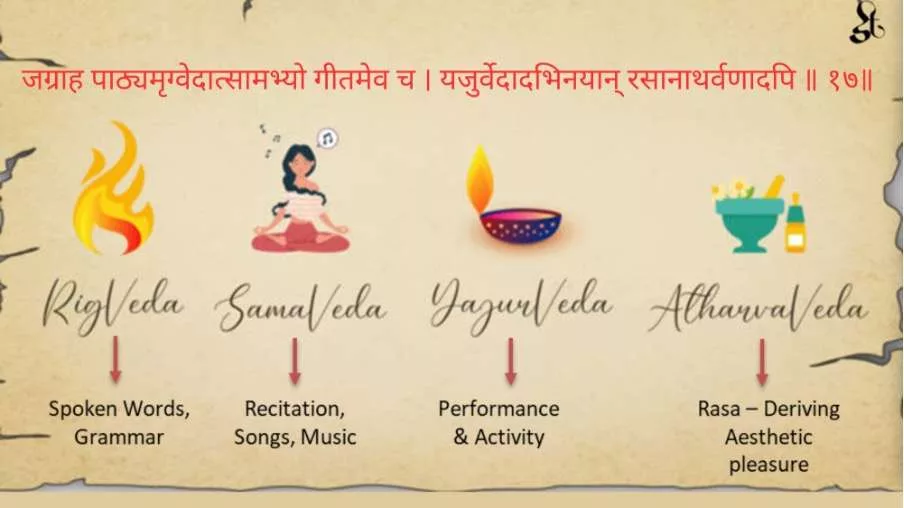
जग्राह पाठ्यमृग्वेदात्सामभ्यो गीतमेव च
यजुर्वेदादभिनयान् रसानाथर्वणादपि॥ १७॥
Rigveda – Pathya (Spoken words, sentences, grammar, prosody, and poetry)
Modulation and the three tones (Udaatta, Anudatta, Swarit) are derived from Rigveda to make the performances engaging.
Samaveda – Recitation, songs, and music:
The Samaveda’s musical notes enrich the natya with melodies.
Yajurveda – Abhinaya (Performance and acting):
Movements and gestures in performances are inspired by the rituals and activities described in Yajurveda, emphasizing purity and sacredness.
Atharvaveda – Rasa (Aesthetic pleasure):
Just as Atharvaveda explains the holistic impact of Rasa, Natyashastra describes how aesthetic pleasure is experienced throughout the body, creating an immersive experience.
Other scriptures considered as Panchamveda include Chhandogya Upanishad, Sutta-Nipata, and Kautilya’s Arthashastra, each integrating profound wisdom.
Thus, from the verse of Natyashastra itself and from the characteristics of Itihaas given in the past, Natyashastra is considered as the 5th Veda.
Natyashastra: A Complete Knowledge System
I am amazed by how Natyashastra weaves together the interdisciplinary knowledge of Rigveda’s spoken words, Samaveda’s music, Yajurveda’s performance, and Atharvaveda’s aesthetic pleasure. It’s astonishing how this ancient text integrates diverse aspects of art, culture, and philosophy, guiding us even in modern times.
Dancing Tales help bring grace to every facet of your life’s dance, from the boardroom to the living room, and beyond.
Disclaimer: The views/opinions expressed in this article belong to the author. Bhogya.online is neither responsible nor liable for the accuracy, completeness, suitability, or validity of any information in the article.

Upasana Tendulkar
This could also be interesting....
Share this:
- Share on Facebook (Opens in new window) Facebook
- Share on LinkedIn (Opens in new window) LinkedIn
- Share on Pinterest (Opens in new window) Pinterest
- Share on WhatsApp (Opens in new window) WhatsApp
- Share on Reddit (Opens in new window) Reddit
- Share on Telegram (Opens in new window) Telegram
- Share on X (Opens in new window) X
- Email a link to a friend (Opens in new window) Email
- More