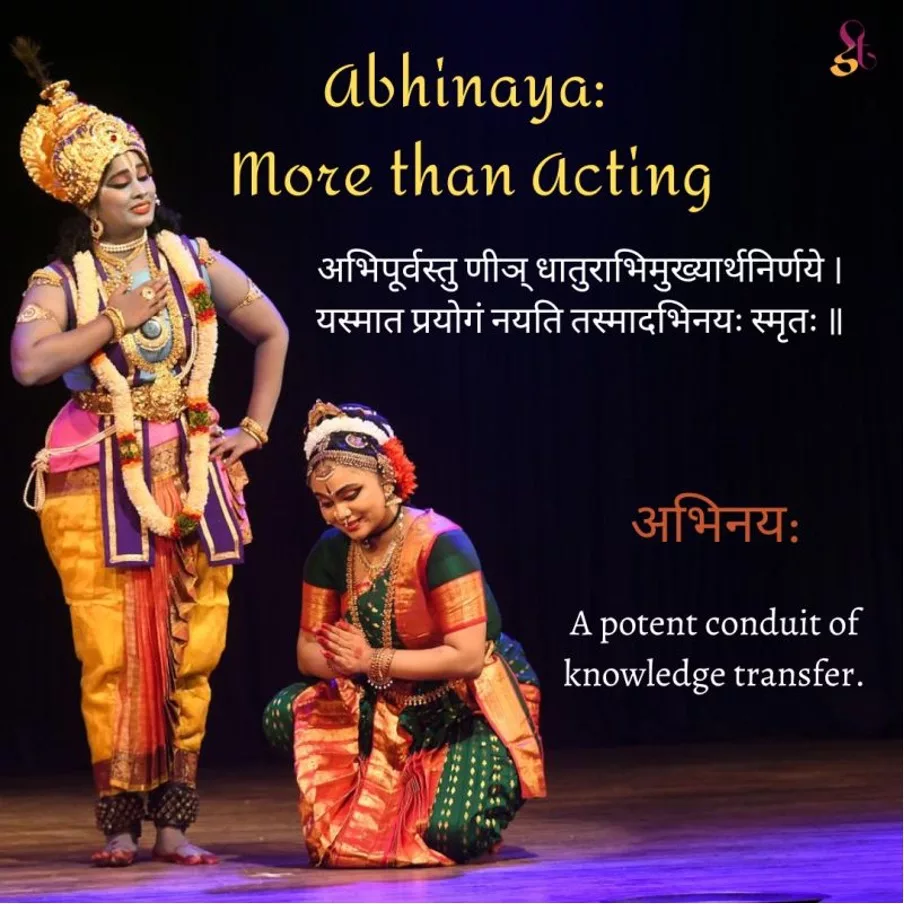
The Deeper Essence of Abhinaya
Natyashastra, as we’ve explored previously, extends far beyond the realms of performing arts; its philosophy and applications are profound and wide reaching. If we agree on this, then it follows that every concept and theme within Natyashastra holds deeper significance than meets the eye, doesn’t it?
Today, let’s delve into the essence of Abhinaya!
In the 8th Chapter of Natyashastra, Abhinaya is beautifully described:
“अभिपूर्वस्तु णीञ् धातुराभिमुख्यार्थनिर्णये । यस्मात प्रयोगं नयति तस्मादभिनयः स्मृतः ॥६॥”
Translation: Just as the root “ni” preceded by “abhi” means ‘carrying the performances (prayoga) of a play to the point of direct ascertainment of its meaning,’ so [the word made out of them] becomes abhinaya (carrying towards).
Abhinaya is the performance that finds completion only when its meaning resonates deeply within the minds of the audience.
Abhinaya as a Tool for Understanding
To understand this, let’s draw a parallel with teaching: a teacher impart knowledge through words, gestures, presentations, and experiments. The lecture becomes a vehicle, guiding students towards understanding.
Similarly, Abhinaya serves as an instrument to awaken understanding in the minds of the audience. Just as a skilled teacher orchestrates a symphony of words, gestures, and visuals to impart knowledge, the Nata (as understood in previous post) harnesses the cosmic energies, weaving them into a tapestry of emotions, movements, and expressions. In this dance, every step, every glance, and every nuance carry profound meaning, resonating with the audience on a physical, emotional, mental and spiritual level.
Abhinaya, with its four types, becomes a powerful conduit for knowledge transfer. Nata, through Abhinaya, share their wisdom with the audience, ensuring a profound learning experience where both logical and emotional aspects are engaged, making the learning enduring.
Why Abhinaya Endures in Traditions
Perhaps this is why traditions like Ram-leela, Dashavatar, or Yakshgana endure year after year—to reinforce timeless teachings. As individual awareness evolves, the received knowledge takes on new depths with each iteration.
Thus, Abhinaya becomes becomes a sacred ritual, a communion between the mortal and the divine, where knowledge flows freely, illuminating minds and awakening hearts. Through this immersive journey, Abhinaya emerges as a pinnacle of experiential learning and knowledge transfer. Abhinaya shines as a beacon of enlightenment, bridging the gap between performer and audience, and illuminating the path to deeper understanding and attainment.
Abhinaya in Modern Life
In modern contexts, Abhinaya’s principles apply across diverse fields. From education to business, therapy to entertainment, its techniques enhance communication, expression, and understanding.
Dancing Tales help bring grace to every facet of your life’s dance, from the boardroom to the living room, and beyond.